
A no-spend month can be one of the quickest ways to reset your money habits without doing anything complicated. If your spending has started to feel a bit automatic, or your bank balance disappears faster than you would like, this kind of reset can help you take back control.
The good thing is you do not need to make your life miserable to do it. A no-spend month is not about punishment. It is about pressing pause on the spending that is not helping you, so you can focus on what matters more. That might be paying off debt, building savings, covering a bill, or simply proving to yourself that you can be more intentional with money.
For some people, the idea sounds extreme at first. However, it can be surprisingly manageable when you do it properly. The key is not to aim for perfection. The key is to make a realistic plan, know your weak spots, and give yourself enough structure to keep going when motivation dips.
If you have already been working on your budget, this post fits well alongside Master Your Budget: How to Track and Control Your Expenses because tracking what is coming in and going out makes a no-spend month much easier to stick to.
What a no-spend month actually means
A no-spend month does not usually mean spending absolutely nothing for 30 days. You will still need to pay for essentials. Rent, mortgage, bills, travel for work, basic food shopping, and anything genuinely necessary still count as normal spending.
What you are cutting out is non-essential spending. That usually includes takeaways, impulse buys, random online shopping, extra beauty spending, unnecessary subscriptions, treats that add up, and all those little purchases that feel harmless in the moment but pile up by the end of the month.
That is why a no-spend month works so well. It shows you the difference between what you need and what you have simply got used to buying.
For example, buying milk, bread, and vegetables is normal. Adding a spontaneous coffee shop stop, three convenience snacks, and a late-night online order is where your month starts to leak money.
Once you see those patterns clearly, it becomes easier to change them.

Why a no-spend month can work so well
One of the biggest benefits of a no-spend month is that it creates a clean break. Instead of vaguely telling yourself you should spend less, you give yourself a clear rule for a short period of time.
That matters because vague goals are easy to ignore. Clear goals are easier to follow.
A no-spend month can help you:
- stop impulse spending
- break emotional spending habits
- save money quickly
- spot waste in your budget
- use what you already have
- feel more in control of your finances
It also helps reduce decision fatigue. When you already know the answer is no for non-essentials, you stop having the same internal debate over and over again.
That can be a huge relief if you are tired of feeling guilty every time you spend money.
Start with a clear reason
Before you begin, decide why you are doing your no-spend month.
This step matters more than people think. If your reason is weak, it is much easier to give up halfway through. If your reason feels specific and personal, you are more likely to stick with it.
Your reason might be:
- I want to save for an emergency fund
- I need to get through a tight month
- I want to stop wasting money on impulse buys
- I need a proper money reset
- I want to prove I can manage without constant extra spending
Try to make your reason concrete. Saving “more money” is fine, but saving £200 towards a bill, holiday, or buffer is better.
When temptation hits, that reason is what helps you keep going.
Decide your rules before the month starts
A no-spend month becomes much harder when you make the rules up as you go along. That is why it helps to decide everything in advance.
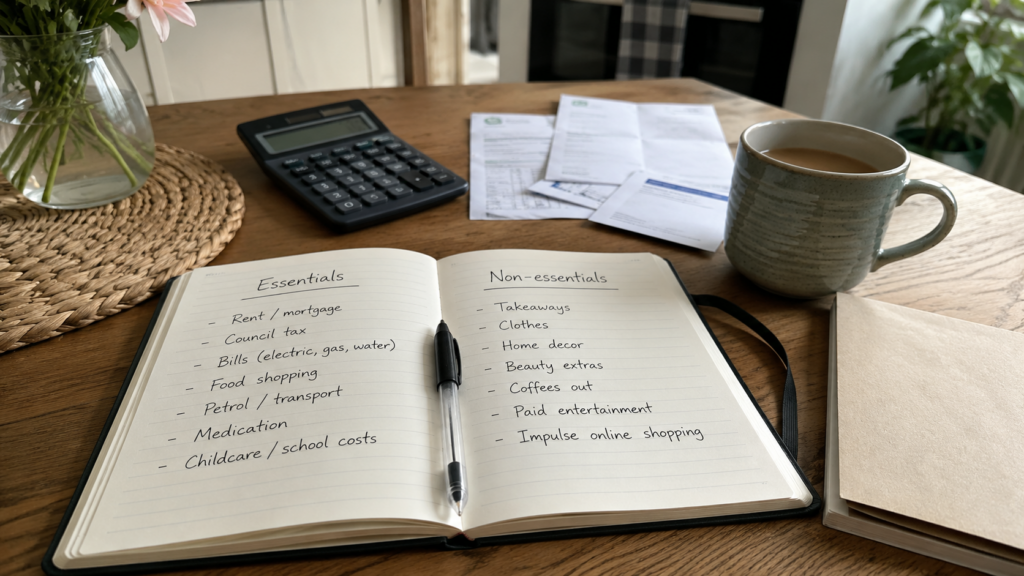
Write down what counts as essential and what counts as non-essential for your month.
Your essentials might include:
- rent or mortgage
- council tax and household bills
- food shopping
- petrol or transport for work
- medication
- school or childcare costs
Your non-essentials might include:
- takeaways
- clothes
- home decor
- beauty extras
- random Amazon orders
- coffees out
- paid entertainment
- browsing-based shopping
Be honest here. The more realistic you are, the better your no-spend month will go.
If you know you already have a birthday meal booked or an unavoidable event, include that before you start. It is better to plan around real life than pretend the month will be perfect.
Do not make the rules too strict
This is where people often go wrong. They get excited, set impossible rules, then feel fed up after a few days.
If your version of a no-spend month is too harsh, you are less likely to complete it. You do not need to make things harder than necessary.
For example, if buying one low-cost social coffee helps you avoid a full spending blowout, that may be a better choice than trying to be overly rigid and then giving up entirely.
Likewise, if you know you need a small budget for children, work lunches, or a specific event, build it in from the start.
The aim is progress, not drama.
A practical no-spend month that saves you money is more useful than an extreme version that only lasts six days.
Prepare your environment before day one
A lot of unnecessary spending happens because your environment makes it easy.
That means preparation matters.
Before your no-spend month starts, do a quick reset:
- remove saved cards from shopping apps
- unsubscribe from marketing emails
- mute tempting brand notifications
- avoid recreational browsing
- plan easy meals with what you already have
- check cupboards, freezer, and toiletries
- make a list of free things to do
- cancel or pause any subscription you do not need
This gives you a much better chance of success because you are not relying on willpower alone.
For example, if every retailer has your card details stored and your inbox is full of “limited time” offers, you are making the month harder for yourself than it needs to be.

Use up what you already have
One of the best parts of a no-spend month is that it pushes you to use what is already in your home.
Most people have more than they think. Food in the freezer, half-used toiletries, cleaning supplies, unused notebooks, gift cards, old clothes that still work, and plenty of things that can carry you through the month.
This is where you often realise how much duplication has been happening.
Instead of buying again, use up what is already there first.
That alone can save a decent amount of money. It can also make you more mindful going forward, because you start noticing how much gets forgotten or wasted.
Make food one of your main focus areas
Food is often where a no-spend month can go very right or very wrong.
If you do not plan for food properly, you are far more likely to end up overspending on convenience. That is why it helps to keep things simple.
Try to:
- plan easy meals
- repeat low-cost favourites
- use what you already have first
- batch cook where possible
- keep quick backup meals ready
- make snacks and lunches part of the plan
You do not need to cook fancy meals every night. In fact, simple usually works better.
A few reliable meals can save you from the “there is nothing in” excuse that turns into takeaway spending.
Give yourself alternatives, not just restrictions
A no-spend month feels easier when you replace paid habits with free or lower-cost ones.
That might mean:
- coffee at home instead of buying one out
- a packed lunch instead of grabbing food on the go
- library books instead of buying new ones
- a film night at home instead of paid entertainment
- a walk, workout, or catch-up instead of shopping for something to do
This matters because spending is often tied to routine, boredom, stress, or habit. When you remove spending, you need something to put in its place.
Otherwise, the month can start to feel like one long list of things you cannot do.
Track your wins as you go
A no-spend month is much easier to stick to when you can actually see the benefit.
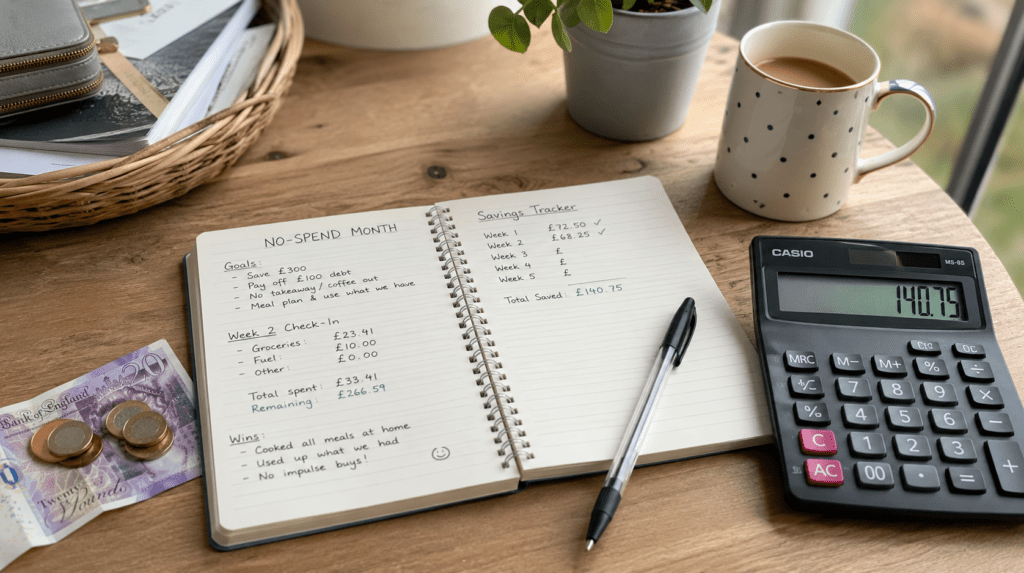
So track what you do not spend.
You do not have to be exact down to the penny every time, but keeping a simple note can really help. If you skip a £4 coffee, note it. If you avoid a £25 impulse order, note it. If you cook from the freezer instead of ordering takeaway, note the estimated saving.
This creates momentum because you start to see your effort turning into real money.
It also makes the month feel rewarding rather than restrictive.
If you want extra structure around this, a printable budgeting tool can help. My Finance Reset Workbook is a digital PDF workbook designed to help you understand where your money is going, cut back on unnecessary spending, and build a simple plan that feels manageable.
Expect a few difficult moments
Even with a good plan, there will usually be moments where your no-spend month feels annoying.
You might feel left out. You might get bored. You might convince yourself one little spend does not matter. You might have a stressful day and want the comfort of spending.
That is normal.
The goal is not to avoid every wobble. The goal is to handle those moments better.
When that happens, pause and ask:
- Do I actually need this?
- Will I still want it in 24 hours?
- Am I buying out of stress, boredom, or habit?
- What am I trying to fix with this spend?
Sometimes just slowing the moment down is enough to stop the spend.
If you slip, do not scrap the whole month
This is one of the most important parts.
If you break your no-spend month once, that does not mean you have failed. It just means you spent money once.
Do not turn one off-plan purchase into a reason to abandon the entire month.
That all-or-nothing mindset is what usually does the damage. One unplanned coffee, takeaway, or impulse buy does not cancel out every good decision you have already made.
Just reset and continue.
A no-spend month can still save you money even if it is not flawless.
In fact, learning how to recover from a wobble is probably more useful than doing a perfect month once.
Think about what happens after the month ends
A no-spend month is useful on its own, but it is even more useful when it teaches you something for the long term.
By the end of the month, ask yourself:
- What did I stop buying that I did not really miss?
- What spending habits surprised me?
- What made the month easier?
- What made it harder?
- What do I want to keep doing?
You might decide to keep one or two habits going, such as fewer takeaways, stricter online shopping rules, or a weekly spending cap for treats.
That is where the real value is. A no-spend month is not just about one month. It is about learning how to spend more intentionally afterwards.

Make your no-spend month fit your life
There is no single perfect version of a no-spend month.
For some people, it works best as a full month. For others, it is better as a no-spend week, a weekend reset, or a targeted challenge where they only cut certain categories.
What matters most is that your version is realistic enough to complete and useful enough to make a difference.
So do not worry about making it look impressive. Make it work.
If you want more practical money tools, planners, and digital downloads to support your progress, you can also browse my Etsy store for simple resources designed to help you feel more organised and in control.

A no-spend month can be a powerful reset when your money feels messy, stretched, or out of control. It helps you notice your habits, cut back on the spending that is not serving you, and use your money more intentionally.
The most important thing is to keep it practical. You do not need a perfect month. You need a realistic one that helps you save money, reduce stress, and build better habits you can actually keep.
If you are thinking of trying a no-spend month, or you have done one before, leave a comment below and share what helped you stick with it.

What is a no-spend month?
A no-spend month is a set period where you cut out non-essential spending and only pay for essentials such as bills, food, transport, and other necessary costs.
Can I still buy food during a no-spend month?
Yes. A no-spend month is about cutting non-essential spending, not stopping essential spending. Basic food shopping is normally included as a necessary expense.
What if I mess up during my no-spend month?
Do not give up. One slip does not ruin the whole month. Reset straight away and keep going. You can still make real progress even if the month is not perfect.
Is a no-spend month a good way to save money fast?
It can be, especially if you tend to spend on impulse buys, takeaways, convenience purchases, or non-essential shopping. It helps you quickly spot where money is leaking.
Do I need to do a full month?
No. You can start with a no-spend week, weekend, or a shorter challenge if that feels more realistic. The best version is the one you can actually stick to.

How To Save Money On Your Bills In 2026
My guide shares practical ways to cut household costs in real-life ways.
Useful if your no-spend month is part of a bigger plan to reduce monthly outgoings.
Money Reset: Simple Ways To Reduce Stress And Boost Savings
If your spending has started to feel overwhelming, my Money Reset post is a helpful follow-on read. It focuses on resetting your habits, reducing pressure, and making saving feel more doable.
Smart Money Moves
My guide is for readers who want more ideas to save money, spend better, and look for extra ways to improve their finances. A good fit if your no-spend month is the start of a bigger money reset.
MoneyHelper Budget Planner
A reliable budgeting tool from a trusted UK source.
Useful for checking your overall spending picture before or after your no-spend month.

Trying a no-spend month can feel much easier when you know other people are doing it too. Share this post with someone who wants to save money, rein in their spending, or have a proper money reset. Tag #MissMoneySaver when you share it.
This post contains affiliate links, which means I may receive a small fee if you sign up for some of the products or services recommended, at no extra cost to yourself.